.
Punam Phuyal
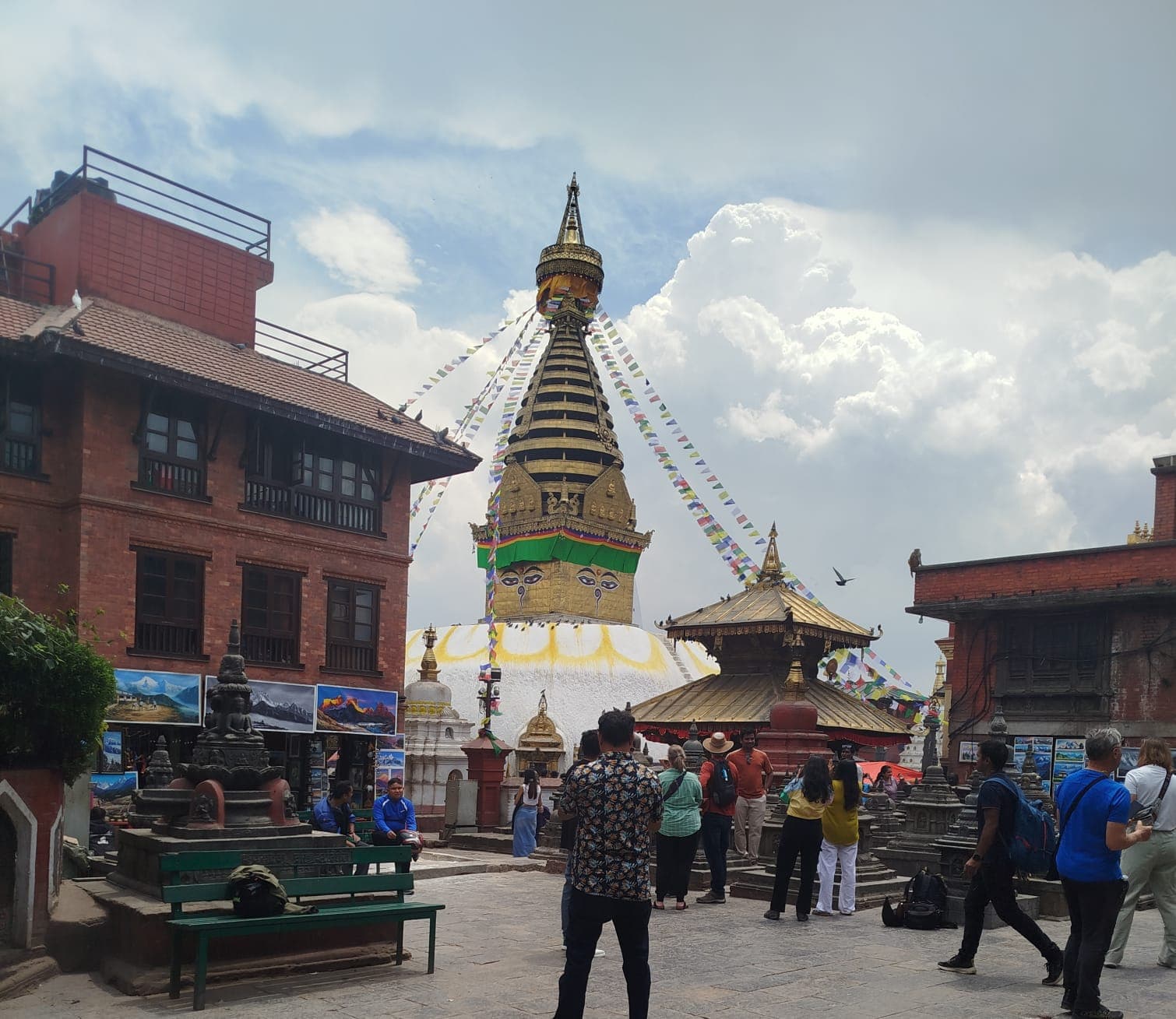

Among the different names of Brahma, Swayanbhunath is one. Literally, the word "Swayambhunath" means "self-originated." It has different names, like Songu, Padmagiri, Gobrichya (like the tail of a cow), Goshringa (like two horns of a cow), Shembo, etc. It is both a naturally and culturally important place to visit in Kathmandu. We can see a good view of the valley and mountains during clear weather. It is a viewpoint of Kathmandu. A variety of plants, along with some endangered species, are found in the forest around Swayambhu. Thus, it is a very important place for botanical study. Similarly, a variety of birds are also found here. Even the birds from different parts of the world come here. Therefore, it is an important place for birdwatching and the study of birds as well.
According to Swayambhu Puran, in the Satya Yuga, Vipashwi, named Buddha, came to this place/hill, which was hidden inside the water. It was a pond. He planted the seed of lotus in the center of the pond named Nagdaha. After six months of cultivation, large and big lotuses and immortal flames came out, and it became an important deity culturally.
Buddha, Rishi Muni, Sadhu, and Shanta, intelligent people from different parts of the world, came to see the Lotus and flame. The story of flame and lotus was heard by Manjushree in China as well. After that, he came to Kathmandu. He covered the lotus and flame by developing a stupa on it, which is called Swayambhunath today. Then he cut the water from the Katwal and made the area suitable for settlement. He extended the settlement up to Gujeshwori. Then he made Dharmakar the first king of Nepal.
Swayambhunath was founded before Buddhism. The Swayambhu Purana mentioned that all Buddhas (Sakyamuni, Kanakmuni, Krakuchanda, Sikhi, and all other Buddhas) have come to get a glimpse of Swayambhunath. Its date of existence is ancient and not recorded by humans. It is believed that the event occurs in Satyayug. These stories were written in the 13th and 14th centuries. Still, there is no proof to know how these stories came.
Krishna came from the north. Badasur makes the valley full of water. Later on, Gwala came to Nepal and let the water pass out from the valley and settled here.
The king named Prachandadev came from India to Swayambhunath and became impressed with its beauty. Instead of returning back, he stays there and keeps on meditating. Later on, he became popular with the new name Shantikar Acharya. He was the teacher of Bandudatha, an expert tantrik. He was alive until Bandudatta went India to bring Machindranath.
Santikar Acharya established five puras for the protection of Swayambhunath. They are Shantipur, Agnipur, Bayupur, Basupur, and Nagpur. He made a large stupa to protect the self-originated lotus and flame. It is believed that he is alive inside Shantipur. Also, if we bring the Thangka written with the blood of a serpent from Shantipur, the rainfall will occur even in drought conditions.
In the context of Nepal, Buddhism had developed since the Kirat dynasty. It was introduced between the 1st and 2nd centuries. There was good development of statues and inscriptions in the Lichhivi period. Swayambhunath was developed as a popular pilgrimage site. The genealogies written by Jayasthiti Malla in the 14th century mention Swayambhunath in it.
There was a big attack on Swayambhu Chaitya in 1349 AD by Samsodhin. The Swayambhu chaitya was broken in that attack. It was rebuilt by Harshaballav Bharo after 12 or 13 years of attack. It was renovated in the 14th century. The renovation was done by Pratap Malla, Jayasthiti Malla, Bhupatindra Malla, and a Tibetan lama.
The present Swayambhu stupa was rebuilt in the 18th century during the period of Rajendra Bikram. Maintainance and conservation work is continuing today as well. Proper protection started after being listed as a UNESCO World Heritage Site in 1976 AD.
Swayambhunath stupa is 77 meters tall from its base. It consist of base, dome, hermica, 13 rings, umbrella, and pinnacle. Each of its part are significant and symbolize body of Lord Buddha.
The big white dome is decorated by prayer wheels with the biggest mantra, "Om mani padme hum." This mantra is a big mantra in Bajrayan. Each mane consist of 1000s script of this mantra. Thus, when we rotate it once, it is believed that we chant it 1000s of times.
Hermica: The rectangular hermica lies above the dome in all four directions. The four cubes indicate the 4 noble truths of Buddha’s teaching:
The eight eyes on each face of the hermica indicate the eightfold path of Buddhism:
The question mark on four sides of the hermical indicates the willingness to know.
There is a big log connecting the pinnacle and base. It represents the connection of the masculine principle (cosmic self)/consciousness and energy (Prakriti).
The entire stupa is considered as the Lord Buddha. The base is his place to sit (asana). Dome is his body, the hermica & Tryodashbhuvan is the head, and the pinnacle is the crown.
There are many historical and cultural deities in the Swayambhunath area. We can see monuments and statues from the Lichhivi dynasty to the 20th century. It has evidence of each period of Nepal, which reflects the development and change in art and architecture with time. It holds a history and shows the continuity of culture from ancient time. All stupas present in this area have been completed until the 20th century.
Manjushree stan is also known as Saraswoti stan by Hindus and Buddha place by Buddhists. It denotes the place where the ignorance/lack of knowledge can be cut with the sword of knowledge. This place is a very important religious place. It was built in the late medieval period. We cannot see much older monuments there.
The Basubandhu stupa was built in the time of Bhuwan Laxmi. It is a relic stupa of Acharya Vasubandhu, who died in this place due to his old age. The stupa lies in between Manjushree Hill and Swayambhu Hill.
Shantipur is one of the pur where we believe that Shantikar Acharya is alive inside. . It was made by him for the protection of Swayanbhunath. The present structure was rebuilt in the Shah period.
The park consists of various chaityas since the Lichhivi dynasty. Many chaityas were built from the 17th to the 20th century. It holds the history, art, and architecture of ancient times. How the development continues.
One of the oldest and most beautiful statues of Nepal. It is a statue of the Lichhavi period dating back to the 7th century.
Karmaraj Maha Bihar is the new and latest structure built in Swayambhunath. It is not old, like 50 or 60 years. It was destroyed in the 2015 AD earthquake and renovated. Also called Bhutani Gumba.
One of the beautiful temples in Shikhar style. Pawan Bhairav is considered one of the good protectors of Swayambhu. It was built in the late medieval period.
One of the beautiful temples in Shikhar style. It was made by Pratab Malla. There is a tantric god (Kakashya) in the inner sanctum. Three times renovated. Two times on fire, once destroyed by earthquake.
Anantapur is a Shikhar-style temple built by Pratap Malla in the name of his queen, Anantapriya. There is a tantric god (Sakasya) in the inner sanctum. It was renovated after being destroyed in natural calamities.
Gyanmala Bhajankhal is the Shah-period monument built for chanting. It is built for the purpose of religious activities.
Big bajra is the oldest and largest bajra of Nepal. It was kept by Pratap Malla. It is influenced by Tibetan Buddhism and symbolizes Bajrayana Buddhism of the medieval period.
Harati is the protector goddess of children. It is believed that Buddha requested her to sit here to protect the children. It was built in the Malla period.
It is 100 years old, Bihar, in Swayanhunath. It is one of the oldest bihar of Nepal.
The Mahakal is the protector god. The statue is one of the beautiful statues of the Medieval period.
One of the beautiful chortens built in the Malla period.
Swayambhunath is a cultural complex with stupas, temples, viharas, and monasteries from the Lichhavi dynasty to the Shah dynasty. The main Swayambhunath Stupa's original structure is a mystery, but it has been modified and renovated in different periods of time. It is one of the important pilgrimage sites of Buddhists and Hindus. It is believed that it was visited by all Buddhas as the most important sacred place. We will gain eternal peace and enjoy the view of the Kathmandu Valley after we visit here. It is also famous as the monkey temple due to various monkeys roaming here. Many Gumbas, such as the red Gumba, the white Gumba, and many more monasteries, can be seen on the north and west sides of Swayambhunath.
...