
Bouddhanath Stupa
Punam Phuyal
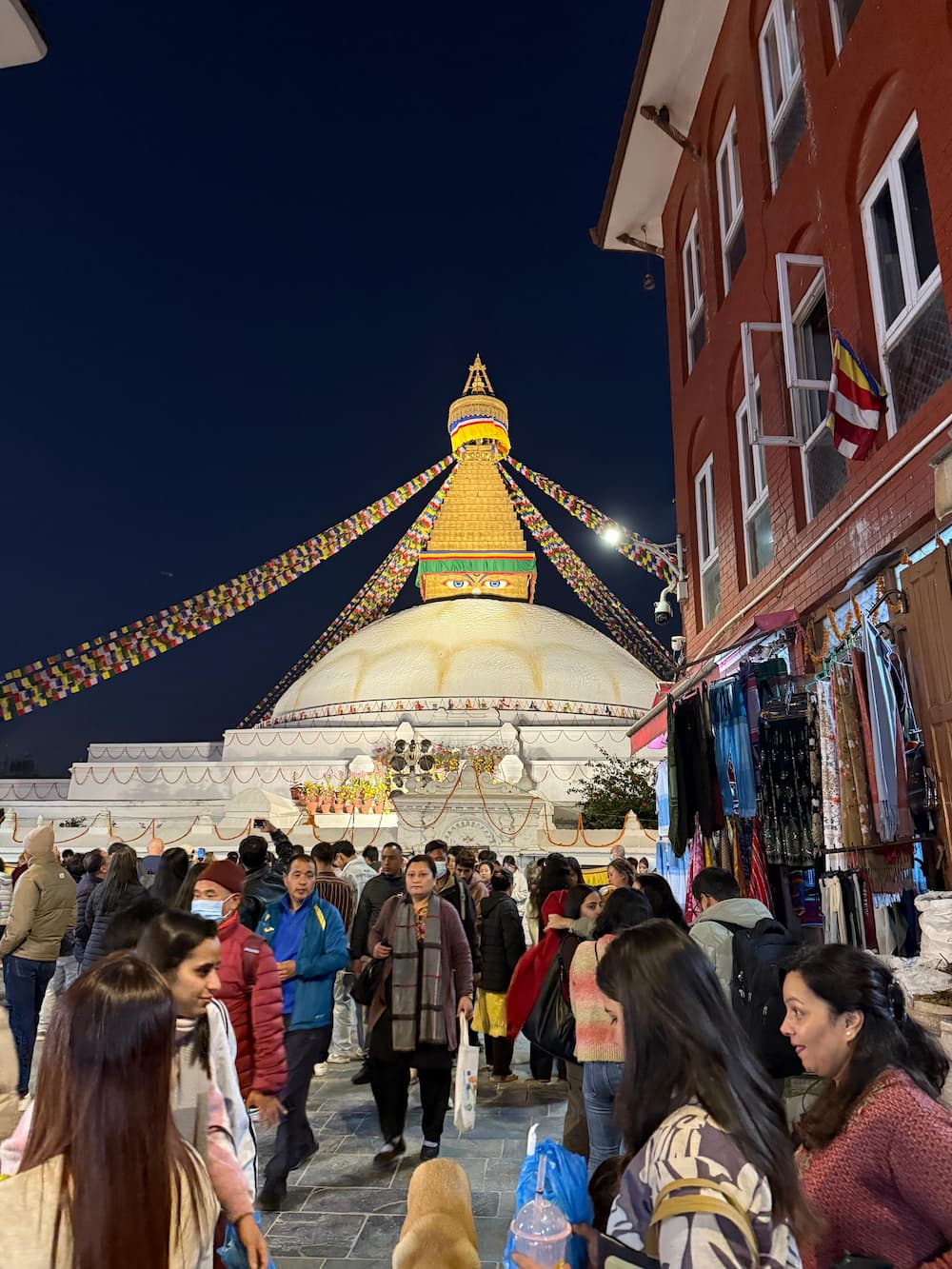
The name of the Boudhanath stupa is Jarung Kha Shyor. It is located in Kathmandu, Nepal, within 7 km from Thamel. It is expanded to 6,756 square kilometers. It is one of the largest stupas in the world. It was listed as a UNESCO World Heritage Site in 1976 AD due to its unexplainable value and importance. Thus, it is the most visited site during sightseeing in Kathmandu. It is a pre-Sakyamuni Buddha stupa. There are two legends related to the Boudhanath stupa, i.e., a Tibetan legend and the Kathmandu Banshawoli in the local language. Tibetan legend is more popular.
Tibetan legend of the Bouddhanath stupa
According to Tibetan legend related to the past life of Padmasambhava, after the parinirvana of Kashyap Buddha, there was a woman owning poultry farming termed as Jadzima. She was a goddess of heaven in her past life, and she had stolen God’s flower, due to which she was cursed by God. Thus, she was born in the Chabahil area in a poor family. She had given birth to four sons from four different partners. She raised all of them alone and completed all responsibilities. After that, she thought to build a stupa by selling the eggs of chickens. She decided to build a stupa in the area and went to ask permission from the king. She was permitted by the king, which is termed "Ja Rung."
The king gives permission to occupy the space equal to the area of skin of an ox. The mother and four sons started to build the stupa. Other rich people and ministers became angry and went to complain to the king and requested to stop the work. Then the king said that he cannot return his words back, termed as Kha Shyor. Later on, Stupa continued to be built, and the mother died. The stupa was completely built after 12 years by her four sons. The year of completion was the rooster year, as in the Chinese calendar. There is a relic of the Kashyap Buddha in the womb sanctum. The Buddhas in the Bhadra Kalpa are the following:
- Krakuchanda Buddha
- Kanakmuni Buddha
- Kashyap Buddha
- Sakyamuni Buddha
The first three Buddhas of the Bhadrakalpa were born in Nepal, whereas the birthplace of Kashyap Buddha is still unknown.
There is the main door in Bouddhanath, which opens once in every 12 years exactly in the year of the rooster. Millions of tourists visit Bouddhanath in the rooster year.
All four sons make a wish in front of Bouddhanath. The first son wishes to be born as Dharmaraj to disseminate Buddhism in the place where people do not know about Buddhism. The 2nd son wishes to be born as a monk in this place. The 3rd son wishes to be born as a Bajracharya guru, and the 4th son wishes to be a minister to balance Dharmaraj, the monk, and the Bajracharya guru. Their wishes become true. They reincarnate in the 8th century.
Story after the birth of Guru Padmasambhav
The first and fourth sons of Jadzima were born in Tibet as king and minister. The second son was born as Shantarakshita in Bangladesh, and the third son was born as Guru Padmasambhav in Udyana, Swat Valley, Pakistan. The king called Shantaraksita from Nalanda to spread Buddhism. Later on, Shantaraksita recommended Padmasambhav from Pharping to build Samye monastery. He suggests building Lo Ghyekar Gompa on Lo Manthan at 3934 m to defeat demons who obstruct making Samye Gompa. On the day of inauguration of Samya Gompa, guru Padmasambhav shares the story about their reincarnation and recalls the construction of Jarung Kha Shyor in their past life. He also explains that the wishes they made in front of Jarung Kha Shyor were fulfilled, and they became king, monk, guru, and minister as determined.
Thus, the Bouddhanath stupa is a wish-fulfilling stupa. Since then, Tibetan Buddhists have visited this stupa in memory of their king and their minister. It is also believed that any person who offers flowers and water or clothes or burns a flame around Bouddhanath, their devotional wishes will be fulfilled. Therefore, it is the most sacred pilgrimage site of Tibetan Buddhism. Yeshe Tsogyal wrote the teachings of guru Padmasambhav, on which we can read the story of Bouddhanath.
Later on the Bouddhanath stupa disappeared as it was completely covered by a hill. People forget about this stupa. Its existence vanished from the Newar community and Tibet for about 200 years. In the 15th century, the Lama named Shakya Zangpo went to visit Samye Gompa and saw the treasure text on the history of Bouddhanath. It explains about the four brothers and construction of the stupa. Also, it will be burried in the future, and its existence will be lost. Then, the person named Zangpo will excavate and renovate the stupa in the future. He was surprised with the text, and his name also matches with Zangpo. Actually, he was the youngest son of Jadzima, who was reborn as a minister, and again he was born as Shakya Zangpo.
Then he came to Nepal as a pilgrimage from Tibet. He found two hills, one in Bouddha and another in Jambu Danda. He examined and excavated the hill and found the Bouddhanath stupa in the buried state. He reconstructed the stupa and moved to Chilighyang and stayed there by making a gompa. His generations are still living there.
Structure of Bouddhanath Stupa
The Bouddhanath stupa is in existence after reconstruction by Shakya Zangpo in the 15th century. It was renovated several times, and the last renovation to date was done after the earthquake in 2015 AD by the team sent via the Dalai Lama from Tibet by creating a fund. The slab was changed, and many statues of Buddhas and Bodhisattvas were found inside the slabs. Many Dharma gurus from Tibet came to visit this stupa and offer a golden pinnacle. There is a big role of Tibetans in the development of the Bouddhanath stupa.
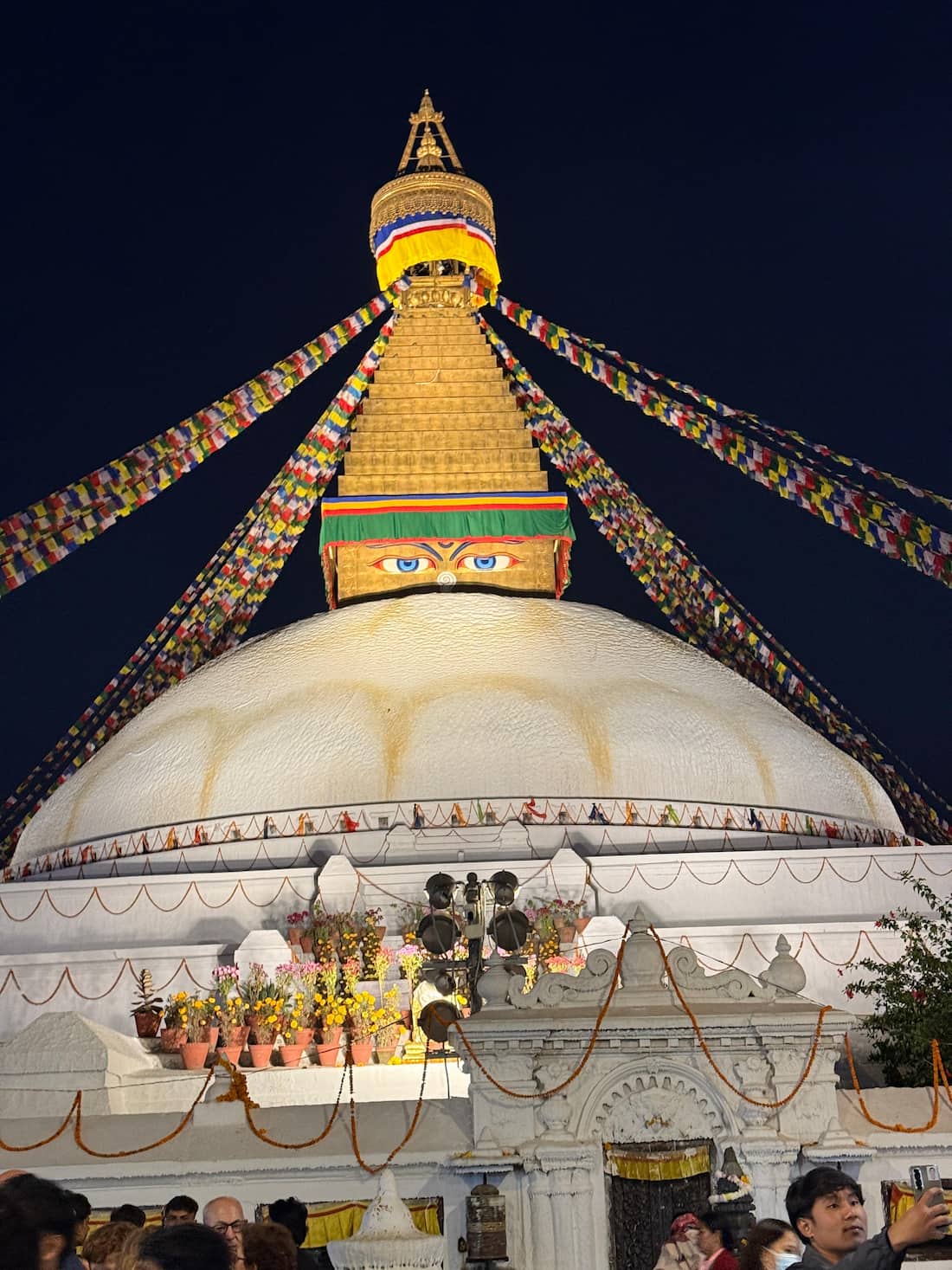
The entire stupa represents five elements:
| Parts of stupa | Elements |
| Plinth | earth |
| Dome | water |
| Hermica | fire |
| 13 stages/trayodasbhuwan | air |
| Pinnacle | space |
Bouddhanath Stupa is one of the largest stupas in the world. The inner sanctum is sunk inside. There are old statues, coins, and books inside the dome. The stupa is mandalakar. It has four stages with nine levels and 36 corners. The mandala represents the Buddhist cosmos and path of enlightenment.
- Dome: The dome of Bouddhanath is circular with a 100 m diameter and 23-meter height. It consists of 108 dhyani Buddhas in its base.
- Hermica: Above the dome there is a cube-shaped Hermica with four faces denoting four noble truths: mental suffering, cause of suffering, and the path to cease suffering. Each face of Hermica has two eyes painted on it. It represents the 8-fold paths of Buddha. (right view, right intention, right speech, right action, right livelihood, right effort, right mindfulness, and right concentration). The eyes are the wisdom of Buddha and show his seeing ability. Similarly, the question mark resembles the Nepali letter 1 and symbolizes unity. It also demotes the willingness to know.
- 13 stages: Above the hermica, 13 stages/rings are kept, which denote the 13 steps to be crossed for enlightenment.
- Lotus: There is a lotus above 13 steps that symbolizes the awakening of consciousness. The lotus always grows in muddy water but blooms clear and beautiful above the water in the presence of sunlight. Thus, it represents rising above ignorance and suffering to reach enlightenment.
- The umbrella above the lotus represents that Buddha is everywhere. He was a Chakrabarti in religion. It is considered that the umbrella protects the three jewels (Buddha, Dharma, and Sangha).
- Pinnacle is the topmost part of Bouddhanath. It resembles Mt. Sumeru, the center of the universe in Buddhist cosmology.
Conclusion
Boudhanath is the most sacred place of Tibetan Buddhists. It was built before the birth of Sakyamuni Buddha. It was renovated by Guru Padmasambhav after his reincarnation as Shakya Zangpo. There is a big contribution of Tibetan lamas and gurus for the development and conservation of this stupa. Tibetan Yelmo, Tamang, and Sherpa people do cora, worship, and rotate mala and mane around the stupa in every morning and evening.
...