
Mount Lhotse, Fourth highest peak in the world
Punam Phuyal
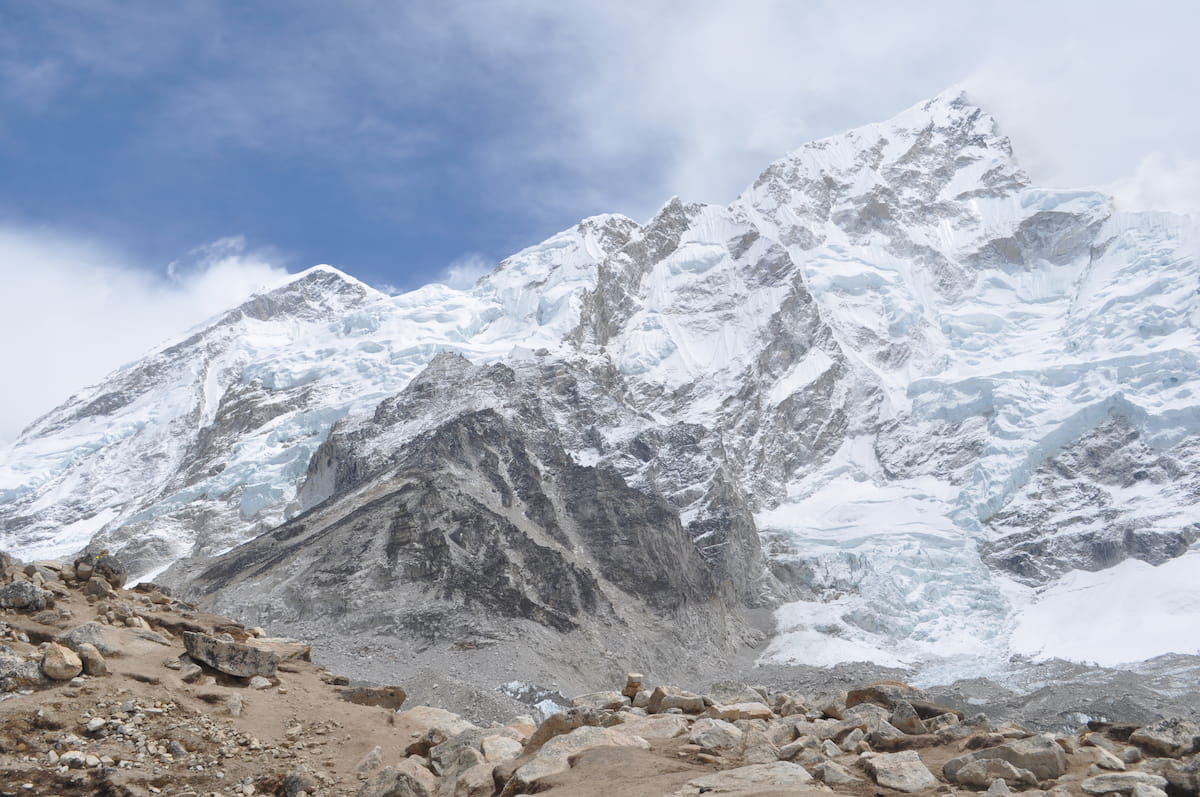
Summary: Mount Lhotse, the fourth highest peak in the world is technically difficult mountain to summit its peak. It shares similar route of Everest expedition above camp III, below Geneva Spur and camp IV. The route diverge to right towards South face. Altogether 33 people have summited the peak since 1956 to 2024. This article is a complete information of Lhotse that gives knowledge on location, expedition, best time and difficulty of this mountain. If you are planning to climb Mount Lhotse then this information is a milestone to gather the knowledge and know the climbing records and fastest speed to summit this peak.
Mount Lhotse, the horseshoe-shaped arc of the Everest massif, is the fourth-highest peak in the world. It lies on the border between the Solukhumbu District of Nepal and the Tibet Autonomous Region of China. The elevation of Lhotse is 8516 meters above sea level. We can see the three subsidiary peaks, Lhotse Middle (8414 m), Lhotse Shar (8383 m), and Lhotse Centre II (8372 m), of Lhotse. Thus, it is one of the iconic mountains that offers an opportunity for mountaineering for adventurous people.
Where is Mount Lhotse located?
Mount Lhotse is located in the Mahalangur Himal range, the subrange of the central Himalayas. It is approximately 3 km away from Mount Everest, which is connected to each other via the South Col ridge. The mountain mass lies on the border between the two countries, Nepal and China.
Lhotse was considered a part of the Everest massif and known as E1 on the Survey of India, 1931. Later on, its elevation of 8516 m was established in 1935 via the Survey of India. The first accurate topographic mapping was completed during the International Himalayan Expedition, 1955.
The meaning of Lhotse
Every word has its own meaning. Mount Lhotse also has a special meaning. The word Lhotse is made from two words: Lho and Tse.
"Lho" means "south."
"Tse" means peak
Thus, Lhotse is the south peak of Everest, which resembles the location of the mountain.
Lhotse face
The western slope of Lhotse is known as the Lhotse Face. It consists of glacial blue ice rising 1125 m from the South Col. This face rises at 40- to 50-degree pitches with an inclination of 80 degrees. Fixed ropes, crampons, and ice axes are required to climb the icy walls.
How hard is it to climb Lhotse?
It is technically hard to climb Lhotse. The climbing route follows the Everest expedition up to the base of the yellow band (golden sedimentary rock located between 7460 m and 7900 m), beyond Camp 3 and below the Geneva Spur & camp 4 at 7906 m. Then diverge towards the right further up to the Lhotse face, which is challenging. The narrow Reiss couloir (vertical crevasse) until the summit of Lhotse's main peak is difficult to pass through.
The secondary summits and extremely steep south face of Lhotse are considered the most difficult and dangerous climbs in the world. The icy northeast face remains unclimbed to date due to its extreme technical difficulty.
Major challenges and facts of Mount Lhotse
- Fourth highest peak in the world
- Thin atmosphere with low oxygen level
- Technically challenging expedition route
- Crevasses
- Avalanches
- Uncertain weather
- Long summit day
- Extremely cold environment
Who climbed Mount Lhotse?
Mount Lhotse was first climbed by Ernst Reiss and Fritz Luchsinger on 18 May 1956 AD. They were the team members of the Swiss Everest/Lhotse expedition 1956.
The first attempt to Lhotse Shar was done by Seppa Mayerl and Rolf Walter on 12 May 1970.
Lhotse Middle was first climbed by Eugeny Vingradsky, Sergei Timofeev, Alexei Bolotov, and Petr Kuzetsov on 23 May 2001. They were the members of the Russian expedition.
Table 1: Successful attempts of Mount Lhotse since 1956 to 2024 (source: wikipedia)
| Year | Expedition team | Climbers' number | remarks |
| 1956 | Swiss Everest/Lhotse expedition | 2 | First ascent of the main summit |
| 1970 | Australian expedition | 2 | First ascent to Lhotse Shar |
| 1977 | German expedition | 1 | Second ascent of the main summit |
| 1979 | Mountaineer from Poland | 7 | Ascent the main summit without supplemental Oxygen |
| 1981 | Bulgarian Himalayan expedition | 1 | Fist solo ascent without supplemental oxygen |
| 1984 | Czechoslovak expedition | 1 | First ascent of Lhotse Shar via south Face |
| 1986 | Reinhold Messner | 1 | Ascent the main summit |
| 1987 | Brazilian Otto Willam Gerstenberger Junior and Swiss Haans Singera | 2 | Ascent the main summit |
| 1988 | Polish climber – Krzysztof Wielicki | 1 | First winter ascent of Lhotse |
| 1990 | Tomo Cesen | 1 | First solo ascent of South face |
| 1990 | Soviet Himalayan expedition members | 2 | Ascent of south face |
| 1994 | Carlos Carsolio | 1 | solo ascent to summit and record a speed at 23 h 50 m from basecamp |
| 1996 | Chantal Mauduit | 1 | First women to reach summit of Lhotse |
| Anatoli Boukreev | 1 | Solo ascent at 21 h 16 min from base camp | |
| 2001 | Yuri Koshelenko - Russian expedition | 1 | First ascent of Lhotse middle |
| 2011 | Michael Horst, American guide | 1 | Summit Mount Everest and Lhotse without descending below camp IV within 21 hours between two summit |
| Arjun Vajpai, Indian mountaineer | 1 | Youngest climber to summit Lhotse | |
| 2017 | Stef “Wolf” Wolput | 1 | First disable person to summit Lhotse |
| 2018 | Jose Luis Sanchez Fernandez | 1 | First latin American to summit Mount Everest and Lhotse in less than 24 hours |
| Hilaree Nelson and Jim Morrison | 2 | First Ski descent from summit of Lhotse | |
| 2024 | Hoskuldur Tryggvason | 1 | First Icelander to summit Mt. Everest and Lhoste |
| Reena Bhatti | 1 | First Indian to summit Mount Everest and Mount Lhotse within 20.5 hours | |
| Total | 33 | ||
Table 1 shows that a total of 33 people ascended the summit of Lhotse from 1956 to 2024.
Best time to climb Mount Lhotse
Spring is the best time to climb Mount Lhotse. Specially April and May are the selective months for summit push due the stable weather, long photo period, moderate temperature, lower wind velocity and best success rate.
How to climb Mount Lhotse?
Mount Lhotse is located south of Mount Everest, sharing the same expedition route up to camp 3. The climbers should turn to the right from the location between Jenava Spur and Camp 3 towards Lhotse Face for the summit push. We should be well prepared before climbing the mountain.
Climbing route:
- Everest base camp trek route (Lukla to Phaking - Namche bazaar – Tengboche – Dingboche – Lobuche – Gorekshep – Everest base camp)
- Climb Camp I via Khumbu icefall
- Camp II
- Camp III
- Lhotse summit push
The entire expedition takes around 55 to 60 days along with return to Kathmandu.
What is the Preparation for Lhotse Expedition?
A lot of climbers want to summit the "14th Peak," and Lhotse is one of them. If you are a beginner and dreaming of chasing the summit of an 8000-meter peak, you must first train your body well and climb some beginner-friendly peaks like Island Peak, Lobuche Peak, Mera Peak, Chulu West, or Pisang Peak. We are based in Nepal, so we write about Nepal's mountains, but you can try similar peaks in your own country too - budget-wise, it will be cheaper. But if you want to climb with a Sherpa, then you can visit Nepal and try these mountains.
After summiting a few mountains without any problem, you can try 7000m peaks like Himlung Himal, Ama Dablam, Baruntse, Tilicho Peak, or Putha Peak. After that, you can try Lhotse and other 8000m peaks. This is our suggestion - some climbers have done 6000m peaks like Lobuche East and gone directly to climb Mount Everest. So it all depends on your physical and mental strength.
Lhotse vs Everest
Lhotse and Everest are both peaks above 8000 meters in Nepal. The special features of these two mountains are shown in the table below.
Table 2: Comparison between Lhotse and Everest
| Features | Lhotse | Everest |
| Elevation | 8616 m | 8848.86 m |
| World rank | 4th highest peak in the world | Highest peak in the world |
| Mountain range | Mahalangur Himal range of Himalaya | Mahalangur Himal range of Himalaya |
| Difficulty | Technically difficult than Everest | Difficult and challenging |
| Expedition duration | 55 – 60 days | 50 – 60 days |
| Total climbers to reach summit | 33 | Around 15000 |
| Best time to climb | Spring | Spring |
Table 2 shows that Mount Lhotse is more difficult to climb than Everest even though its elevation is lower.
FAQ
Is Lhotse taller than K2?
No, Lhotse is not taller than K2. It is the fourth-highest peak in the world, whereas K2 is the second-highest peak in the world. K2 is 95 m taller than Lhotse
Is Lhotse higher than Everest?
No, Lhotse is not higher than Everest. It is 332.86 m smaller than Everest and located on its south in a distance of 3 km.
Is Lhotse easier to climb than Everest?
No, Lhotse is not easier to climb than Everest. The expedition route to Lhotse follows the route to highest peak in the world up to Camp 3 just below yellow bands. Then the route is technically challenging due to extremely steep icy walls and crevasses. Only 33 people have successfully climbes Mount Lhotse since 1956 to 2024 whereas around 15000 people have summit Everest.
Who climbed Mount Everest and Mount Lhotse?
Michael Horst (an American guide), Jose Luis Sanchez Fernandez, Hoskuldur Tryggvason, and Reena Bhatti had climbed Mount Everest and Mount Lhotse consecutively.
Who can climb Mount Lhotse?
An expert climber with mountaineering experience can climb Mount Lhotse. It is more difficult than the Everest expedition, but those climbers who summit the highest peak in the world can climb Lhotse by accepting more challenges.
What is the height of Mount Lhotse?
The height of Mount Lhotse is 8616 meters above sea level.
Who is this guide for?
This guide is for all nature lovers who are curious about mountains. It is detailed information for trekkers, climbers, researchers, bloggers, and planners who are dedicated to peak climbing. This article is best for:
- Everest region trekkers who want to know about Mount Lhotse
- Climbers who aim to summit this mountain
- Travellers having desire to know about mountain peaks
- Bloggers seeking information about this mountain
- Researchers on mountains and expedition history
Conclusion
Mount Lhotse is the fourth-highest peak in the world, standing at 8616 m above sea level. There are three subsidiary peaks, Lhotse Shar, Lhotse Middle, and Lhotse Center II. The first men to climb Mount Lhotse are Ernst Reiss and Fritz Luchsinger. They climbed the peak on 18 May 1956. Since then, 33 people have summited the peak until 2024. The summit push to Lhotse is relatively harder than Everest. The latest record shows that the fastest climber of this mountain is the first Indian, Reena Bhatti who climbed the peak within 20.5 hours.
...