
How many camps are on Mount Everest?
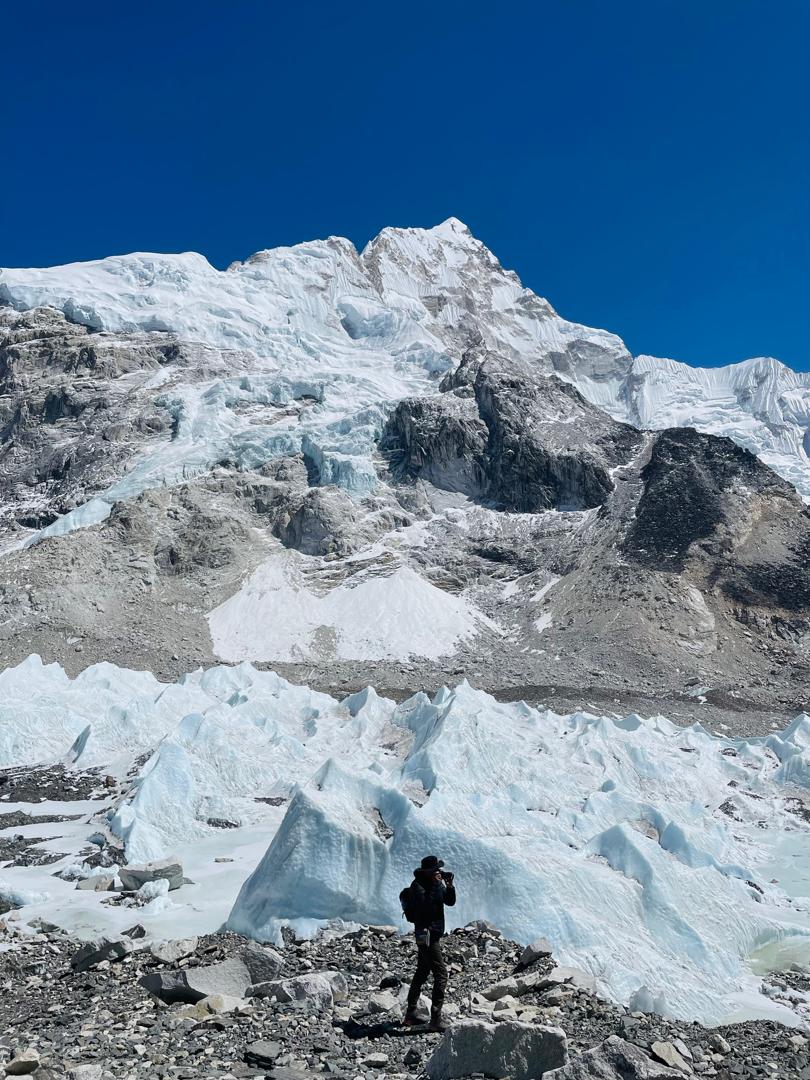
Mount Everest is the tallest mountain in the world with the highest dimension of energy. It is a tectonic mountain formed from the collision of the Indian subcontinental plate with Eurasian plate since 50 million years ago. The lateral compression of Indian continental plate gives rise to the Himalaya, and the height is in progress with continuous collision between the plates. Mount Everest is a part of Mahalangur Himal, a sub-Himalayan range. It is a border Himalaya that separates two countries Nepal and China. There are two base camps on each country's side. South Base Camp lies in Nepal and North Base Camp in China. The highest peak in the world lies in Nepal. It is pride of Nepalese and a symbolic mountain to recognize the country in the world.
Nepal is also known as the country of Mount Everest. Sherpa and Tibetans named it as “Chomolungma” or “Qomolangma”- the goddess mother of the world. In English, it is called Holy god. It’s Nepali name is Sagarmatha.
Base camps of Mount Everest:
Base camp refers to the foot of the mountain. It is the beginning point of an expedition. Both face of Mountain Everest are attraction points for a mountaineer. This article tends to give detailed information of base camps and higher camps of Everest.
There are two base camps of Everest: South Base Camp and North Base Camp. The South Everest Base Camp is located at 5364 meters above sea level. It is the most popular for adventurous trek in the world. The exact location where the first climber of Mount Everest, Edmund Hillary and Tenzing Norgay Sherpa, made their camp before starting their summit push is called base camp for trekkers today. It takes 8 days to reach there from Lukla. We should cover approximately 55 km to reach the base camp of Everest. Only the expedition team can stay there. Trekkers need authorized permission to settle camp, whereas the expedition team stays many days on Everest Base Camp for preparation and acclimatization.
Facts of the South Everest Base Camp
- Elevation: 5364m
- Distance from Lukla: 55km
- Difficulty level: moderate
- Difficulties: Altitude sickness
- View: Khumbu icefall, Khumbu glacier
- Vegetation: absent
- Terrain: rocky moraines with snow-capped peaks
- Who can go? – Physically fit people of any age group
- Permits: Sagarmatha National Park permit and Khumbu Pasang Lhamu Rural Municipality permit
- Best time to trek: Spring and autumn
- Last Settlement: Gorakshep
- Views: Mt. Everest, Ama Dablam, Thamserkhu, Lhotse, Nuptse, Cho Oyu, etc
How to reach South Everest Base Camp (EBC)?
Trekking and helicopter tour are two methods to reach the South Everest Base Camp. 14 days EBC trek from Lukla is the best option to explore the unique Sherpa culture, Sagarmatha National Park, Ancient monasteries, Chorten, Gumba, and diverse landscapes. It is necessary to acclimatize at Namche and Tengboche to adjust to changing climatic conditions. Following the itinerary of Everest base camp trek, we can complete our journey to South Base Camp.
Besides trekking, a heli tour is the best alternative to reach South Base Camp and explore the highest mountain in the world.
North Base Camp of Everest
The North Base Camp is in the Tibet Autonomous Region, China. It’s elevation is 5150 meters above sea level. Driving from Rongbuk Monastery is the best way to reach North Base Camp. Trekking to North Base Camp is less popular as we can drive to the base whereas the Advanced Base Camp trek is more popular to gain higher elevation.
Advanced Base Camp
Advanced Base Camp is 6400 m; it is located 22 km from North EBC. It takes 3-4 days to reach the final destination. We would pass through the intermediate camp (5800 m) and East Rongbuk Glacier (5300 – 6300 m) to reach Advanced Base Camp.
- Trekking duration: 4 days from base camp
- Distance from North base camp to advanced base camp: 22 km
Camps of Mount Everest
Besides base camps, both faces of Everest have different camps:
Camps on the South side (Nepal)
Camp I (5364 m / 17,598 ft)
- Location: Just above Khumbu icefall
- The first major stop after EBC
- Also known as Western CWM
- Acclimatization site for climbing Everest
Besides base camps, both faces of Everest have different camps:
Camp I (5364 m / 17,598 ft)
- Location: Just above Khumbu ice fall, 27.987560° N and 86.876311°E
- The first major stop after EBC
- Acclimatization site for climbing Everest
- Distance from base camp: 6-7 km
- Duration of climb: 5-8 hours
- Difficulty: most technical, difficult
Camp II (6, 065 m / 19900 ft)
- Location: 27°58'56.30"N and 86°53'28.63"E
- Distance from base camp: 12-13 km
- Distance between Camp I and Camp II: 5-6 km
- Duration to climb from Camp I to camp II: 4-6 hours
- Route: western CWM
Camp III (6400 m / 21,000 ft)
- Location: 27°58'22.86"N and 86°54'55.92"E
- Distance from base: 15-16 km
- Distance between camp II and camp III: 3 - 4 km
- Duration to climb Camp II to camp III: 6 - 7 hours
- Route: steep ice walls of Lhotse face
Camp IV (7950 m / 26,000 ft)
- Location: 27°58'24.84"N and 86°55'47.97"E
- Distance: 3-4 km far from Camp III
- Duration: 8-10 hours
- Route: Yellow band and Geneva spur on southeast ridge
*Yellow bands are major landmark to show transition from icy Lhotse face to the camp 4
*Geneva spur is a large rock buttress above camp 3. The name come from swiss mount everest expedition, 1952 on which the route to south col was developed.
Camps on North Face of Mount Everest (China)
Camp I (7000 m – 7020 m)
- Located on a steep snow slope on the north col
- We should ascend 600m from Advanced Base Camp (ABC)
- Duration to climb from ABC: 5,6 hours
- Technical climb using fixed ropes
- Temperature: -30 to -40
Camp II (7500m -7800 m)
- Located on the north ridge
- Elevation gain: 500 m
- Challenges: strong crosswind and low oxygen
- Acclimatization site
Camp III (8,230 m – 8300 m)
- Death zone
- High risk of altitude sickness
- Challenges: low oxygen, strong winds
- Technically challenging
Conclusion: How many camps are on Mount Everest?
Mount Everest has two base camps North and south side. Climbing from the northern side is technically difficult as compared to the southern face. Altogether southern face has four camps and the northern part have three camps above Advanced Base Camp. Trekking to South Base Camp is adventurous, with 8 days hiking from Lukla, whereas we can drive to the northern base camp.