.
Punam Phuyal
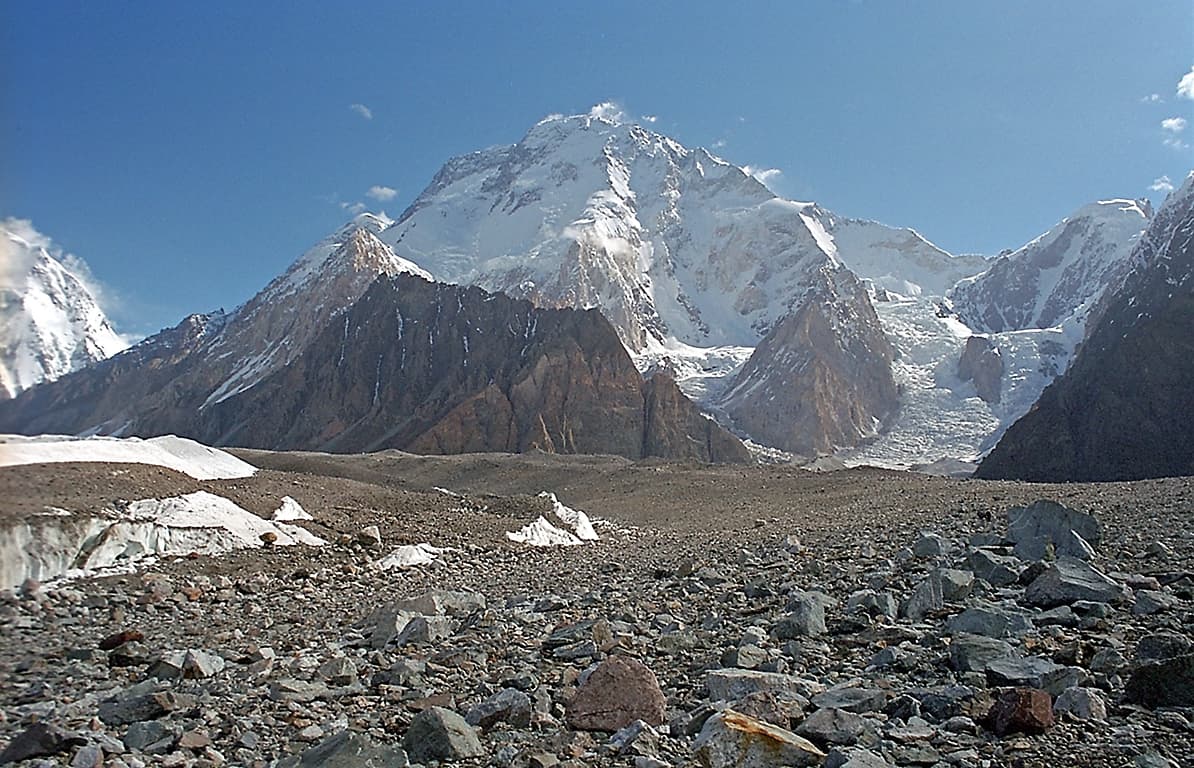

Summary: A broad peak disaster occurs on 30 July 2026. The disaster was an avalanche which occurred about 6600 m on the slope between Camp 2 and Camp 3. The deadliest event swipe away the 10 renowned climbers of the world including the most popular Nirmal Purja, also called Nim’s dai. The death of entire team was declared on August 1, 2026. This event is painful for all people who respects mountains, adventure and travelling. This article is all about broad peak and the actual cause of the broad peak avalanche 2026. It gives details on who were affected, why the mountain is dangerous and what the climbers can learn from this tragedy. This article is for all climbers, trekkers and mountaineering association who keeps on interest on mountain disaster. It is an informative content for all mountaineering community, trekking and tourism industry that gives details information on cause, casualties and lesson lernt from Broad Peak Avalanche 2026.
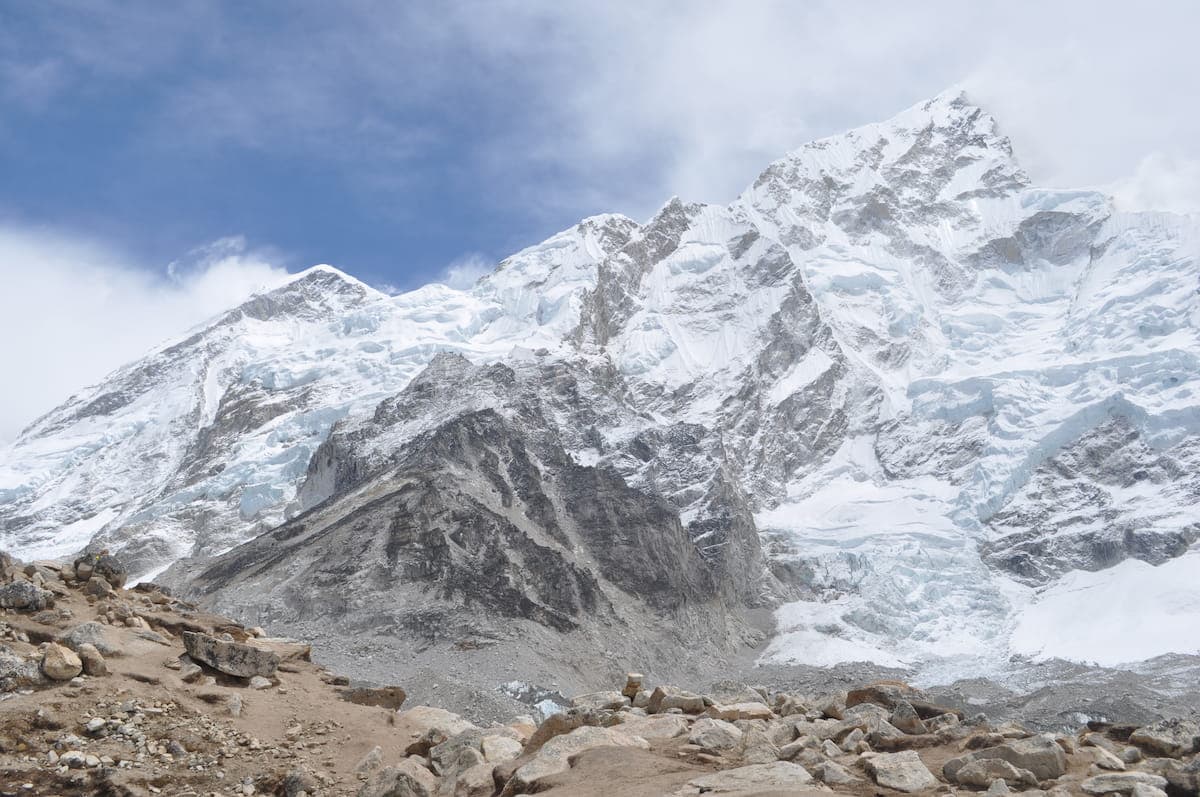
The broad peak is located in Gilgit-Baltistan, Pakistan, spinning to Xinjiang China. It is the 12th highest peak in the world, standing in the Karakoram range. It is one of the highest peaks in the world, above 8000 m. The elevation of Broad Peak is 8051 meters above sea level. The summit of this mountain is extended over 1.5 kilometers in length which gives broad appearance, thus known as Falchan Kangri as well.
Broad Peak is a part of the Gasherbrum massif, which is around 8 kilometers from the second-highest peak in the world. It takes around 1.5 hours to reach K2 base camp from the base of Falchan Kangri.
There are two subsidiary peaks of the Broad Peak that stand above 8000 m. They are Rocky Summit (8028 m) and Broad Peak Central (8011 m).
Broad Peak Avalanche 2026 is one of the deadliest mountaineering disaster in recent years. The weather was unstable before the avalanche. The strong windstorm with high humidity was reported on 18 July. The dropping temperature and heavy snow fall increase fresh snow on the mountain and resulted the avalanche on 30 July, 2026 at around 9: 30 am (Pakistan time). It struck all the 10 summit-bound climbers from the Elite expedition.
The high pressure of flowing snow pushes the climbers deep down to the mountain. According to the records of GPS trackers, climbers fall to several hundred meters. Four climbers came down to the base camp and six climbers fell approximately 800 to 1000 meters down. The rapid falling, strong force from the avalanche, and difficult terrain did not let the climbers to save themselves.
Entire team lost the communication and remain out of contact from 3oth July. The avalanche was unknown for a day. As soon as the news of avalanche was flashed out, the rescue team from Pakistan military personnel and high-altitude experts were deployed on the accidental site. The body of three climbers, Pur Bahadur Gurung (Nepali), Nathira bint Ahmed Abdullah AI Harthy (Omani), Sarah Mallory Geis (American) were identified on 31st July from the base of Avalanche, opposite of Broad peak base camp. The weather was bad that makes the rescue team unable to recover another climbers’ condition on 31st July, Friday.
The death of the expedition leader, Nirmal Purja and the entire team was declared on August 1, 2026 by his company Elite exped, His body was recovered from 5700 meters on August 5, 2026. Along with his body Chinese climber Wang Zhong, Nepali climbers Nima Sherpa and Kili Pemba Sherpa was also brought down to Base camp.
The bodies of 7 climbers were subsequently airlifted by the Pakistan Army to Skardu for repatriation to their country and families. The body of Sohail Sakhi (Pakistani climber), Nawang Thindu Sherpa (Nepali) and Mallory Geis (American) are unrecovered and resting in peace on broad peak.
There were 10 climbers pushing up to Broad peak summit before the avalanche. The uncertain disaster became the deadliest event that killed well experienced Guinness world record holders who played significant role in the mountaineering field. This event recalls 1996 disaster which swipt away the well renowned climbing guides: Robert Edwin Hall, Andy Harris, Scott Fischer and Tsewang Samanla. Altogether 8 climbers lost their life in 1996 Mount Everest disaster. Thus, these events proof that mountaineering is a risk that does not deal with experts and experience. No matters how much experienced we are, disasters and worse weather can treat us to death.
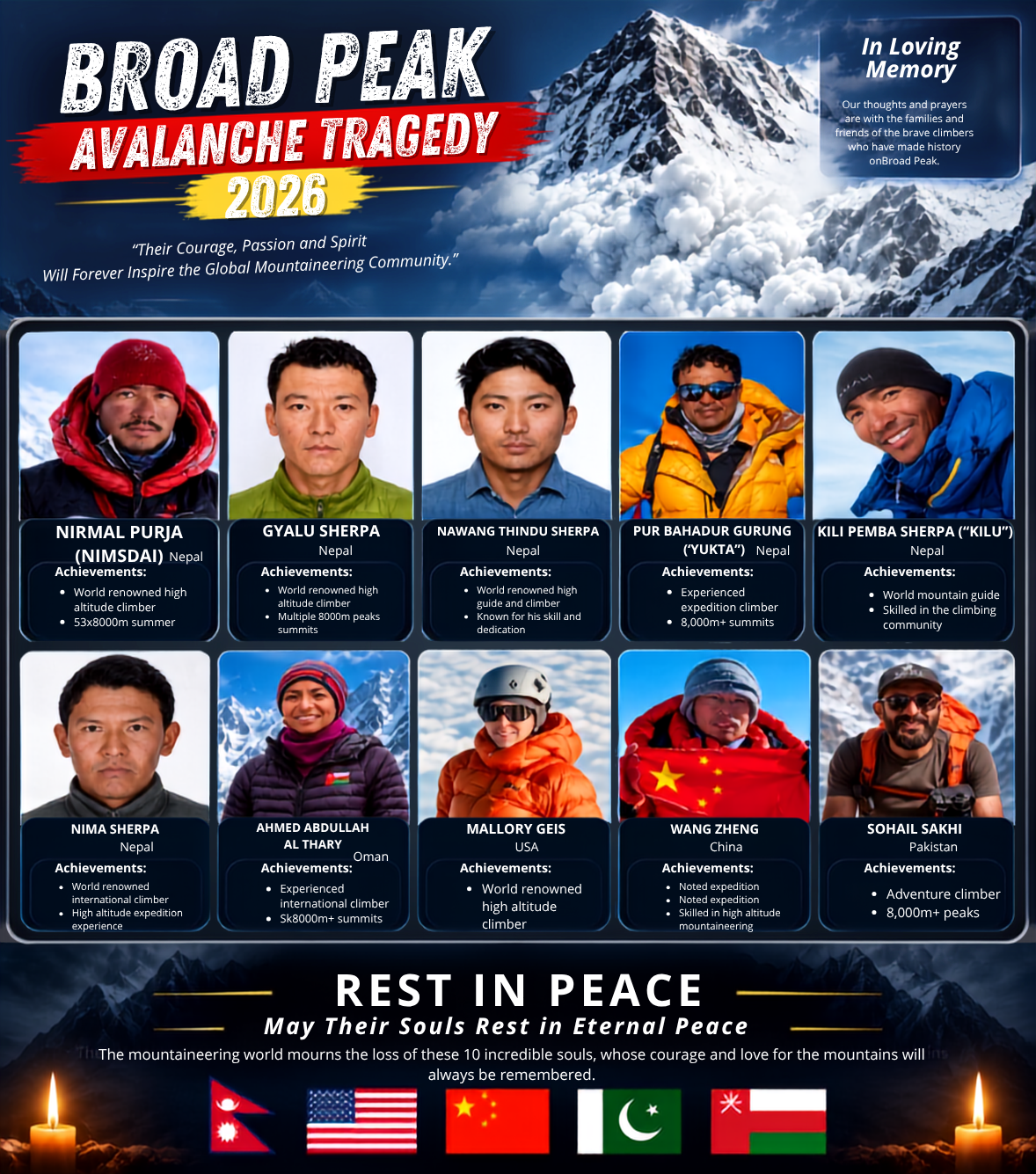
The casualties of the Broad Peak avalanche 2026, Pakistan are:
| Name of climbers | Nationality | Body recover from Mountain |
| Gyalu Sherpa | Nepal | Aug 1, 2026 |
| Kili Pemba Sherpa (“Kilu”) | Nepal | Aug 5, 2026 |
| Sarah Mallory Geis | America | Not recovered |
| Nadhira Al Harthy | Oman | 1st July 2026 |
| Nawang Thindu Sherpa | Nepal | Not recovered |
| Nima Sherpa | Nepal | Aug 2, 2026 |
| Nirmal Purja (Nimsdai) | Nepali/United Kingdom | 5 Aug, 2026 |
| Pur Bahadur Gurung (‘Yukta”) | Nepal | 31st July 2026 |
| Sohali Sakhi | Pakistan | 12 Aug 2026 |
| Wang Zhong | China | Aug 2, 2026 |
Gyalu Sherpa was a renowned high-altitude mountain guide from Khijidemba, Okhaldhunga, Nepal. He had set a Guinness world record by summiting Mount Kanchenjunga, the third-highest peak in the world, three times in a single climbing season. He worked as a climbing guide for a decade. He worked as mountaineering guide for Mera peak climbing, Himlung himal expedition and continued to the summit of Cholatse, Lenin peak, Manaslu, Kanchejunga and Everest Expedition. He successfully climbed all 14 eight thousanders.
Kili Pemba Sherpa (Kilu) was a senior mountain guide from Rolwaling, Dolakha district Nepal who climbed mountain with Japanese, french, British, German and Norwegian teams. He successfully submitted all 14 eight thousanders. He spent 30 years of his life on guiding people to the top of the world. He had drawed international attention by guiding Double leg amputee Rustam Nabiev (Russian) to the summit of Manaslu and double leg amputee Xia Boyu (Chinese) to the summit of Everest. His loss is a loss of a legendary Himalayan climber whose space will never be recovered.
Sarah Mallory Geis was a mountaineer from San Antonio, Texas. She was a Pilates instructor and stepped away from her business to fulfill her dream of mountaineering. It was her first attempt to climb the mountain above 8000 m. Unfortunately, she could not make it. The avalanche dismissed from the world.
Nadhira bint Ahmed Abdullah Al Harthy was the first Omani woman to climb Mount Everest. She was an Omani civil servant working for Oman’s Ministry of Education. Her dedication towards climbing peaks was alive even though she suffered from altitude sickness while climbing Kilimanjaro and remain unsuccessful during the Ama Dablam expedition. She was one of the most courageous Omani women who climbed challenging mountains (Everest, K2, Manslu, Ama Dablam, and Nanga Parbat) on her life time.
Nawang Thindu Sherpa was born in Makalu Rural Municipality 9, Sankhuwasabha, Nepal. He was one of the professional mountain guides working with seven summit treks. He began his climbing carrier with a successful climb Island peak followed by Mount Everest, Lhotse, Manaslu, Kanchenjunga, and Makalu. He guided clients to the summit of Ama Dablam and many other high mountains. His death is a loss of a young, energetic, experienced climber and guide who contributed a lot to the mountaineering sector.
Nima Sherpa was a hardworking, honest, and courageous young climber who climbed four mountains over 8000 meters. He was born 0n 1990 in Chyaksa Boda, Makalu Rural Municipality-2, Nepal. He had entered mountaineering from the trekking sector. His guidance to Everest base camp trek and many other trekking in Nepal made him an expert. He became an experienced climber gradually. He represented Nepal in international mountaineering expedition.
Nirmal Purja was a well renowned Nepali – British mountaineer who served in the British army with the Brigade of Gurkhas before stepping on mountaineering career. He was born in dana village, Myagdi district, Nepal. He started his climbing career in 2012 by climbing Lobuche east without previous mountaineering experience. Dhaulagiri summit in 2014, was his 1st ascent to peak above 8000 meters. Then he climbed Mount Everest in 2016. His journey was continued on Himalaya. He led Gurkha Expedition “G200E” to commemorate 200 years of Gurkha service on the British Army. After giving resignation from SBS in 2028, his focus was only on high altitude mountaineering. He set Guinness world records with unbelievable achievements in short period of time.
Nimsdai’s death is a significant loss for the mountaineering world. His fame in the international mountaineering increased with his world record of climbing 14 peaks above 8000 meters within 6 months and 6 days. His documentary in Netflix recognized him to the world. He proved “nothing is impossible” from his mountaineering. His saying, "Giving up is not in blood, sir," is inspiration to people with high determination. He was the most accomplished climber of his generation and regarded as a major figure in modern high-altitude mountaineering. The world will remember him from his records and history he made on peak climbing.
Nirma Purja climbed all the highest peaks with a total of 49 ascents on mountains above 8000 meters. Mount Everest was the most climbed peak, followed by Mount Lhotse 6 times.
Pur Bahadur Gurung also called Yukta was a well experienced mountaineer and expedition guide who climbed Mount Everest 10 times and 12 highest peaks of the world. He was born in Laprak village, Gorkha district, Nepal, and struggled for survival from his young age. He started his career as a porter and subsequently progressed as an assistant guide and trekking guide and became a high-altitude expedition guide. His death is a great loss in mountaineering of Nepal and the world.
Sohail Sakhi was a skilled mountaineer, athlete, and trip leader of Epic Expedition. He was born in Aliabad, Hunza valley, Pakistan. He lost his life on Broad Peak while guiding Mallory Geis to the summit. He started mountaineering career in his early 20s after spending his free time as a trekking guide and moved into climbing guide. His passion, humility, and courage to ascent the summit are a source of inspiration for countless climbers.
Wang Zhong was a high-altitude mountaineer who successfully summited 12 highest peaks in the world. He was a fearless mountaineer who dedicated several years to completing his ambition of summiting all fourteen peaks above 8000 m. He was near to his goal and on the way to summit the second last peak, leaving Shishapangma the last one. Unfortunately, his dream remains incomplete, and his body rests in Broad Peak. The world lost the passionate climber.
We extend our deepest condolences to the families, friends and entire mountaineering community of Nepal, China, Pakistan, USA and Oman on behalf of loss of 10 experienced mountaineers due to the Broad Peak tragedy. The death of 10 climbers at once is the biggest loss that could not be healed. To the climbers: Nimsdai Purja, Kili Pemba Sherpa, Nawang Thindu Sherpa, Gyalu Sherpa, Nima Sherpa, Pur Bahadur Gurung, Nadhira Al harthy, Sohil Sakhi, Mallory Geis and Wang Zhong who died due to the Killer broad peak avalance, we honour your memory, courage and final Journey. May all souls rest in peace.
Broad Peak is the 12th highest mountain in the world. Even though it receives less attention than the Everest and K2, the climbers choose to summit all 14 peaks above 8000 meters. It is one of the most challenging mountains due to some hazards like:
Avalance is one of the hazards that is unpredictable. It occurs due to the accumulation of a large amount of snow on a mountain that moves down with the gravitational pull. Avalance varies based on its speed and distance. The large amount of unstable snow and ice falling at once gives less time to react. There is less chance of survival of climbers after being stuck by avalanche. Heavy snow accumulation is the major cause of avalanches on broad peaks.
The broad peak elevation is 8051 m, which consists of a death zone above 8000 m. Thus, the mountaineers can feel extremely low oxygen and atmospheric pressure during the summit push, which may result in critical sickness.
The weather of the Karakoram range is unstable and keeps on changing quickly. Strong winds, snowfall, poor visibility, and extreme low temperatures can make climbing and rescue dangerous. The extreme weather delayed the rescue of 10 climbers struck by an avalanche in 2026.
The broad peak contains steep sections, exposed ridges, and glacier terrain that remain a challenge for climbers. Climbers must navigate difficult terrain during rope fixing and peak climbing.
Every event leaves a trace that gives a lesson for a learner. The broad peak tragedy is a nightmare that leaves deep scars on the climbing community. Thus, every climbing and expedition team should learn a lesson from this event so that similar accidents do not occur in the future.
The major lessons that a climber learns from the avalanche on Broad Peak are:
The Broad Peak Avalanche 2026 was a heartbreaking event for the international mountaineering community. This event swept away the well-experienced 10 climbers along with renowned mountaineer Nirmal Purja. Nepal loss six mountain guides who were playing a significant role in trekking and expeditions in Nepal. This event taught to step back on risk rather than taking an extraordinary challenge in high altitude.
The mountaineering community and we, Mission Summit treks and expedition will always remember the climbers who never retuned from Broad Peak struck by avalanches. A big thanks to the rescue team who recovered the bodies by working in dangerous conditions.
...